


|
The wealthy merchant Ye Jin-tu’s residence located at the intersection of Section 2, Chongqing North Road and Bao’an Street was established in 1927. It has been reconstructed by developers. Now, it is the office building of the Council of Indigenous People named “Beifu Dadaocheng.” The original facade on the side of Bao’an Street is still remained but the other side on the Chongqing North Road is an imitation. The magnificent red brick construction and Baroque-style decorations clearly indicate the presence of an affluent merchant in the Japanese colonial period. The character “泰(Tai)” on the gable represents “Jin-tai-heng” Store managed by Ye Jin-tu, and the constructional design of pineapple sculptures symbolizes Ye’s business of pineapple cans production. Ye Jin-tu was born in Dajiala. He went to Dadaocheng for his trading business of marine products in 1900s and established Jin-tai-heng Store on the backstreet of Mazu Temple (Now the street is named Minsheng West Road). He then established “Taifang Business Association” and dedicated himself to pineapple can production. In 1924, he founded a pineapple can factory near Jiuqutang Station in Fengshan, Kaohsiung. The existing three formerly preserved old constructions were registered as historical architecture in 2004. By conducting pineapple trade, Ye Jin-tu became wealthy and had the name of “Pineapple King” in the Japanese colonial period. Among Tai-yi-hou Papers, only 27 letters of Jin-tai-heng from 1907 to 1918 were preserved. Except trading marine products, Ye Jin-tu had sent product samples to Tai-yi-hou in September 1913 as an attempt to expand the foreign market of pineapple cans. In December 1914, he developed a new product, longan can, and asked Tai-yi-hou to investigate the market price in Nagasaki (see figure 4). Even though few letters regarding Jin-tai-heng Store remained, we can still have a glimpse of Ye Jin-tu’s merits of trading marine products and staring up his pineapple can business. 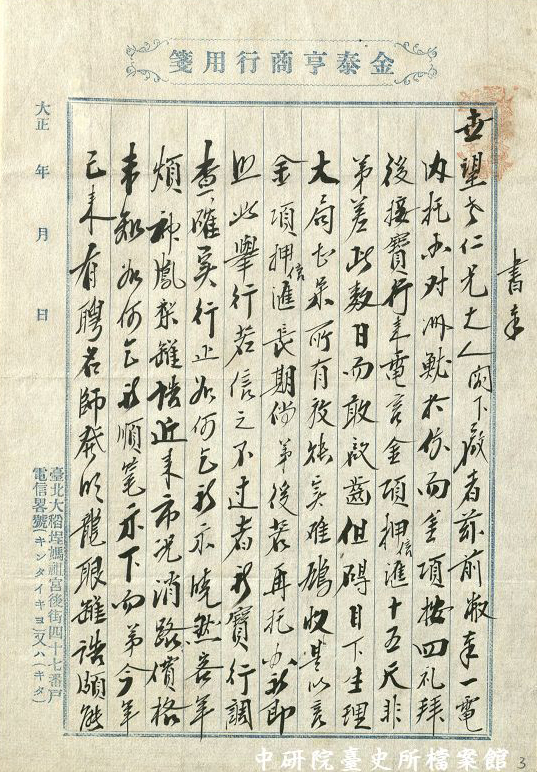 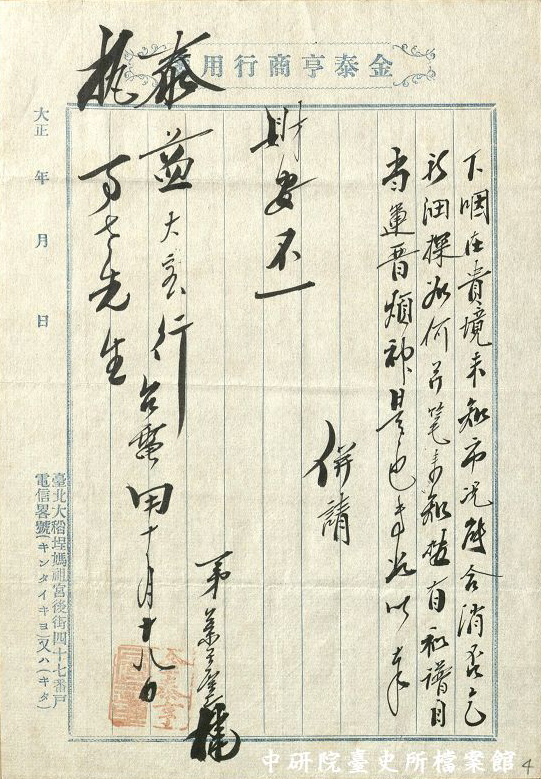 Figure 4: The letter written by Jin-tai-heng Store to Tai-yi-hou on December 5, 1914. (Source: Papers of Tai-yi-hou in Nagasaki, the digital archives of the Archives of Institution of Taiwan History) |
  |